ฝนธรรมชาติ

เมื่อไอน้ำในอากาศ ลอยขึ้นสู่เบื้องบนที่มีอากาศเย็น จะกลั่นตัวเป็นละอองน้ำ
แอโรซอล (aerosol) เช่น ฝุ่นละออง, เถ้าภูเขาไฟ, อนุภาคเกลือ, อนุภาคอินทรีย์...
จะเป็น nuclei ให้ละอองน้ำเหล่านี้ มารวมตัว กัน ก่อตัวเป็นก้อนเมฆ
เมื่อละอองน้ำมีปริมาณมากขึ้นจนอากาศ พยุงละอองน้ำเหล่านี้ต่อไปไม่ไหว
ละอองน้ำรวมตัวกันตกลงมาเป็นเม็ดฝน
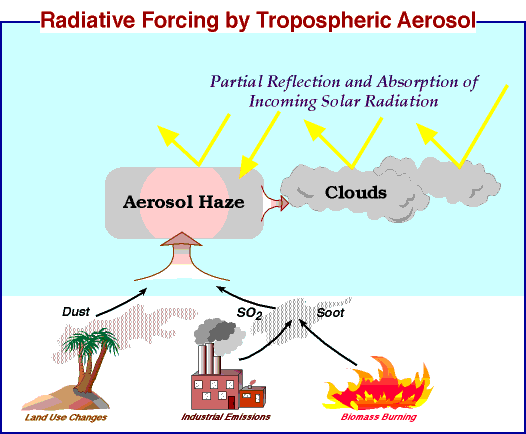 ละอองลอย หรือ แอโรซอล (aerosol)
คือ ของผสมประเภทคอลลอยด์ที่ประกอบด้วย
- อนุภาคของแข็งขนาดเล็ก
(ฝุ่น หรือ ฝุ่นละออง ขนาดเส้นผ่านศูนย์กลางอยู่ระหว่าง 10–100 ไมโครเมตร)
ที่แขวนลอยในอากาศ
มีแหล่งกำเนิดมาจากแหล่งกำเนิดธรรมชาติ
เช่น เกิดจากภูเขาไฟ(ในรูปเถ้าภูเขาไฟ) ไฟไหม้ป่า(ในรูปเขม่า) การกระเซ็นของละอองน้ำทะเล
ฝุ่น ควัน(ในรูปไอควัน) การกัดเซาะผิวหน้าดินโดยลม เป็นต้น
และฝุ่นที่เกิดจากโรงงานอุตสาหกรรม, เขม่าจากรถ เป็นต้น
- ของเหลวที่เป็นละอองฟุ้งกระจายในอากาศหรือในก๊าซอื่น
เช่นหมอก ของเหลวที่เป็นละอองน้ำอยู่ในอากาศ
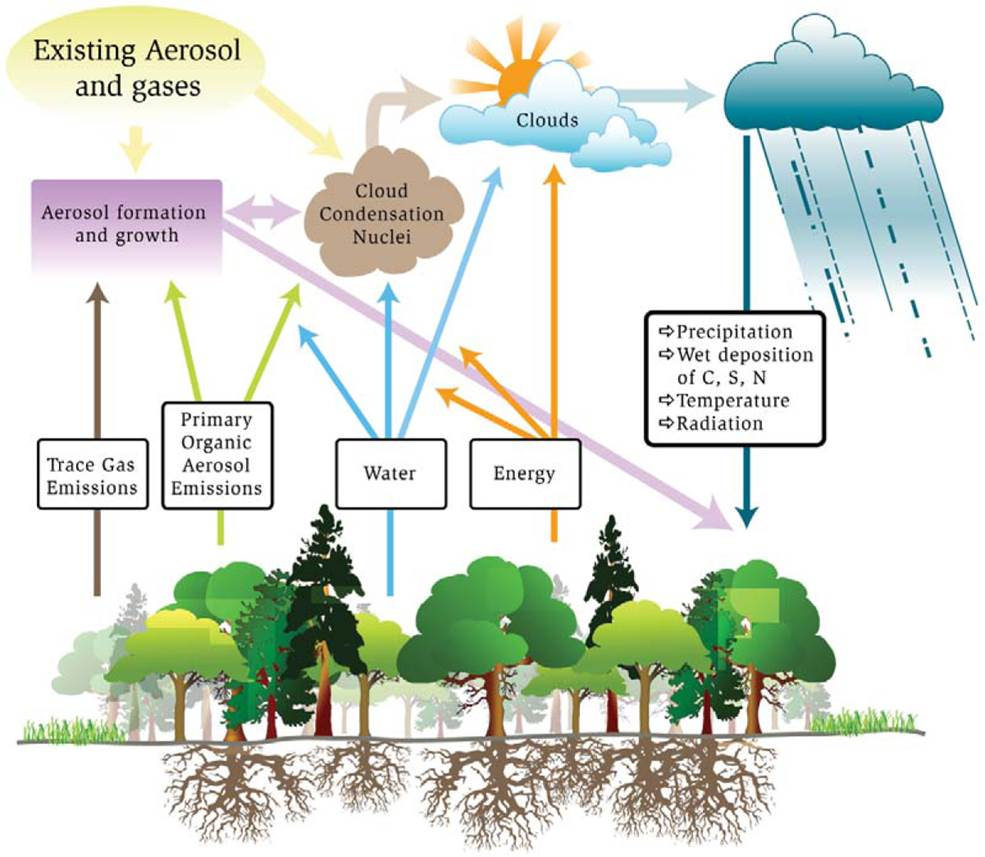
ต้นไม้ผลิตไอน้ำ และใช้แอโรซอล เป็น nuclei ที่ทำให้ไอน้ำ มารวมตัวกัน
เมื่อไอน้ำลอยตัวสูงขึ้น พบอากาศที่อากาศเย็นลง
ไอน้ำกลั่นตัวเป็นละอองน้ำ เกิดเป็นก้อนเมฆ ก่อนตกลงมาเป็นฝน
|
Organic Aerol Emissions
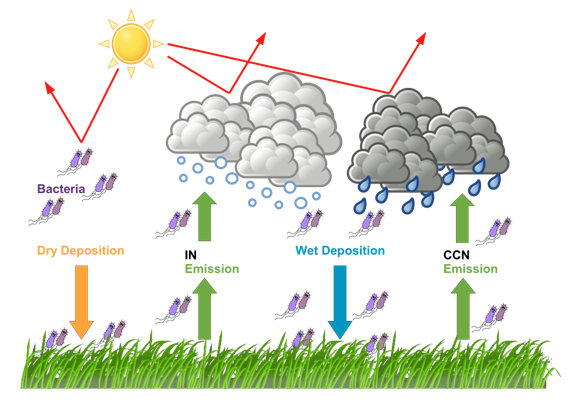
Bacteria emitted from vegetation surfaces
can serve as ice or cloud condensation nuclei in mixed-phase clouds.
|
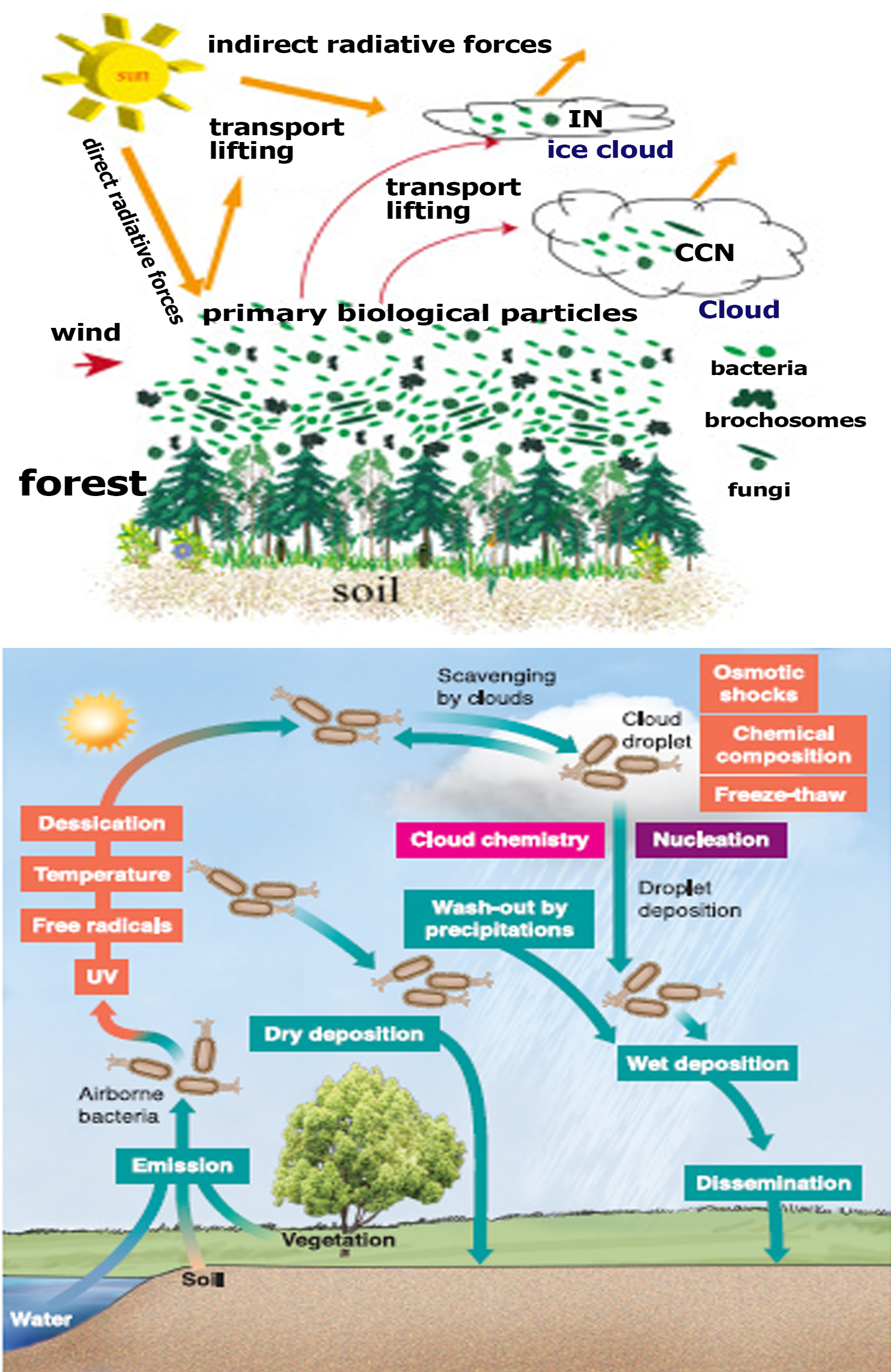
Pseudomonas Syringae "rain-making bacteria"
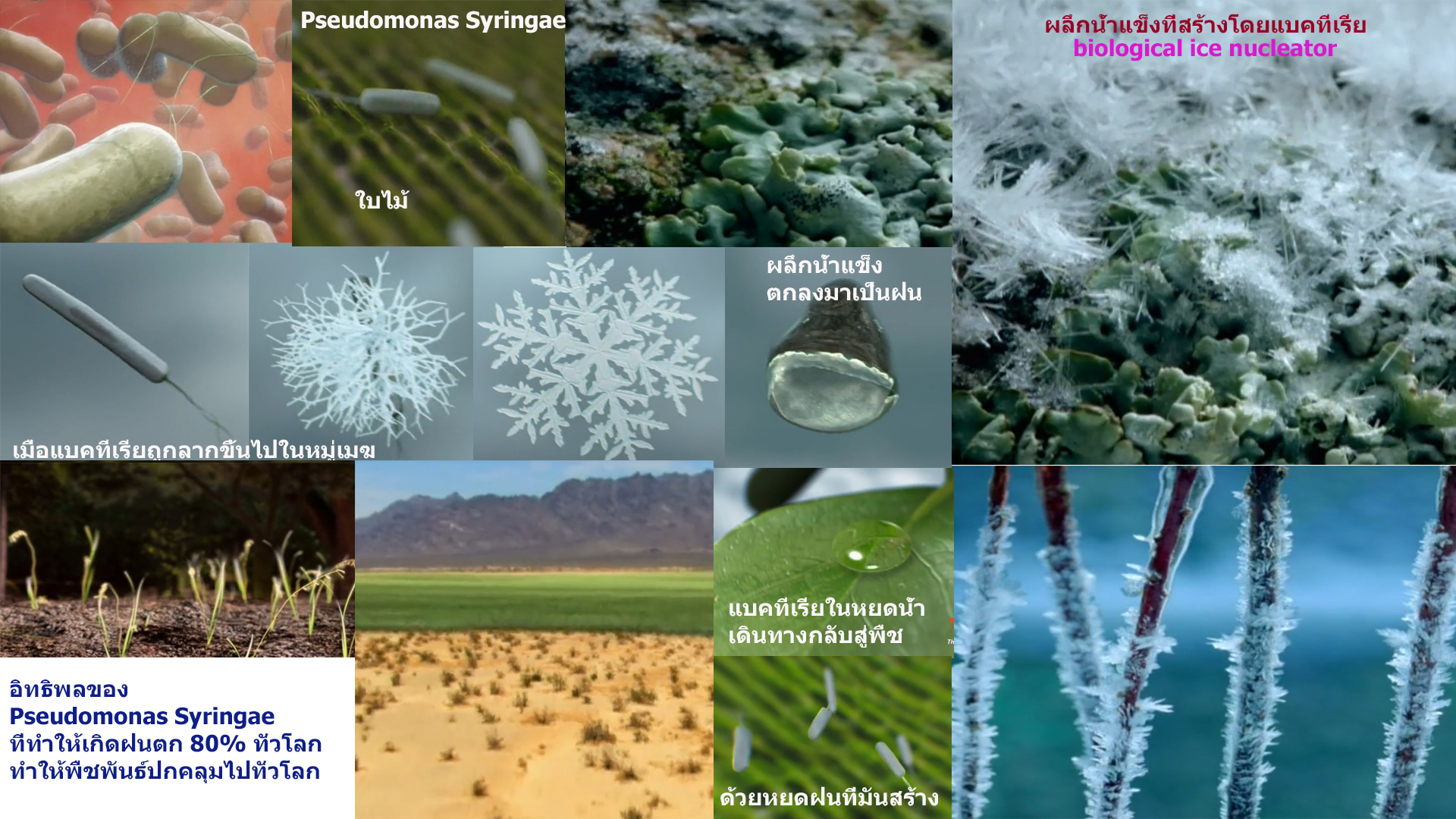
Pseudomonas Syringae อาศัยอยู่กับพืชหลายชนิด
มันมีโปรตีน (ina protein) อยู่รอบนอก ที่คอยจับโมเลกุลของน้ำ
ให้อยู่ในรูปแบบโครงสร้างที่คล้ายผลึกน้ำแข็ง
โปรตีนของมันทำให้น้ำแข็งตัวก่อนถึงจุดเยือกแข็ง
เมื่อ Pseudomonas Syringae ถูกลากขึ้นไปในหมู่เมฆ
โปรตีนของมัน
จะทำให้โมเลกุลของไอน้ำเกิดการตกผลึกเป็นน้ำแข็ง
เมื่อผลึกน้ำแข็งรวมตัวมากขึ้น จะตกลงมาเป็นฝน
(อนุภาคแข็งตัว(Freezing nuclei) หรือเม็ดน้ำขนาดใหญ่
จะดึงเม็ดน้ำขนาดเล็กมารวมตัว กัน เป็นเม็ดฝน)
Pseudomonas Syringae อาศัยอยู่ในน้ำฝน เพื่อตกกลับมายังพืชอีกครั้ง
มันจึงอาจเป็นสาเหตุของปริมาณฝน 80% ที่ตกลงบนโลก
มันช่วยให้ผืนโลกปกคลุมด้วยพันธ์พืช
|
If the bacteria were "grown" in dry locations,
wind would carry colonies high,
where P. syringae could act as
the coolant around which
water vapor condenses
into raindrops (or hail).
Although rain also forms around dust motes,
volcanic ash, and salt particles
when it's cold enough,
P. syringae cools vapor into precipitation
at higher temperatures,
because of its "ina protein".
"ina protein" (ice nucleation active)
A single bacterium, according to
Dr. Snow at the University of Montana,
can make enough protein
to nucleate 1000 snow crystals.
The P. syringae bacterium's ice nucleation activity
causes water to freeze on plant leaves or fruit,
so it weakens the protective cover,
allowing the bacterium to burrow in,
feed, and reproduce.
|
Pseudomonas Syringae
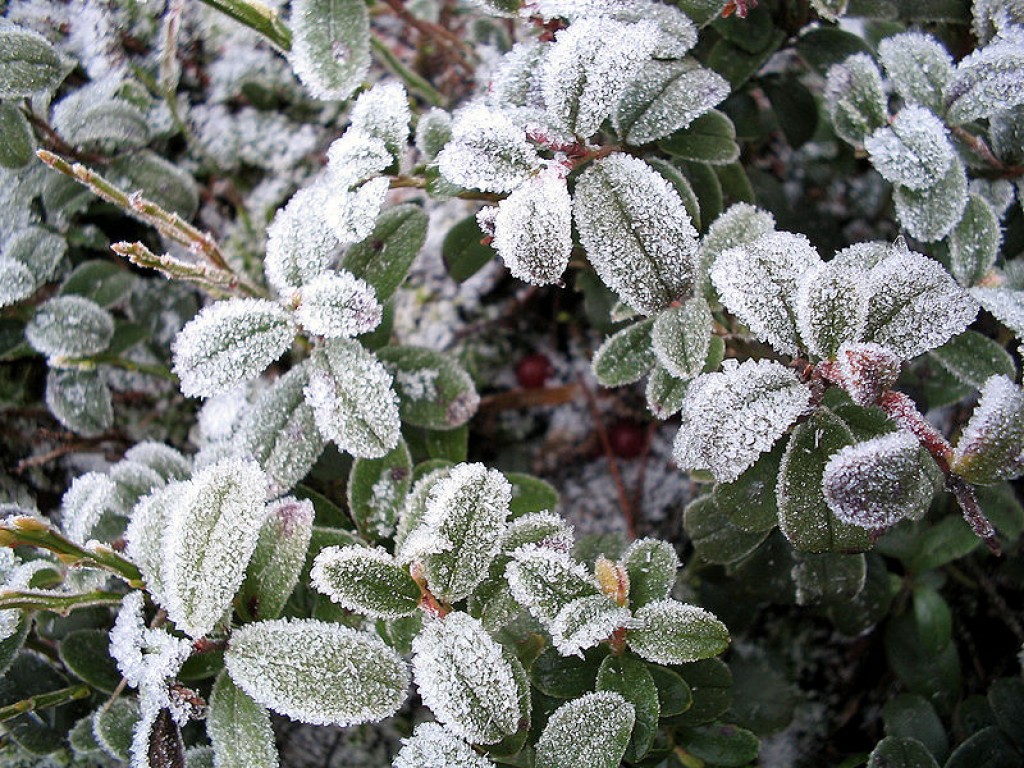
P. syringae's ice nucleation ability
helps make frost on plants
Dr. Lindow,
a plant pathologist at UC Berkeley,
is credited with
the first identification of
P. syringae
as a biological ice nucleator
in the 1970s,
during his graduate studies.
He discovered that
the bacteria produces
an "ina protein"
(ice nucleation active)
that causes water to freeze,
which softens a plant's skin,
so the bacteria can dig under it
to suck its juices.
But the freezing action
doesn't stop there.
Wherever the bacteria goes,
it carries that freezing action
with it.
|
Precipitation Studies
Recent studies of
meteorologists and plant pathologists
are proving that the bacteria plays a crucial role
in the formation of all forms of precipitation
(raindrops, hailstones, and snow).
 The rain-making bacteria Pseudomonas syringae.
In 1982 Russell Schnell,
attending the University of Colorado at the time,
noted that a tea plantation in Western Kenya
was having hailstorms 132 days of the year.
He discovered that
the hail was forming around
tiny particles carrying P. syringae
that were kicked up by tea pickers in the fields.
The rain-making bacteria Pseudomonas syringae.
In 1982 Russell Schnell,
attending the University of Colorado at the time,
noted that a tea plantation in Western Kenya
was having hailstorms 132 days of the year.
He discovered that
the hail was forming around
tiny particles carrying P. syringae
that were kicked up by tea pickers in the fields.
|
How Rain Forms
In 2008 a microbiologist
at Louisiana State University
discovered that 70-100%
of ice nucleators in snow
freshly fallen in Montana
and Antarctica were biological.
In May 2012, a researcher
at Montana State University
found high concentrations
of bacteria in hailstones
that had fallen on campus.
Based on this and
additional evidence gathered,
scientists are now wondering
if there might be an entire ecosystem
of rain-making bacteria
living and reproducing up
in the stratosphere.
Most of the research so far
has been carried out
by plant biologists,
however their results are reviving
the interest of atmospheric physicists.
At least 30 scientists worldwide are
currently researching the role of
bacteria in forming rain.
They are speculating about
the possibility of directing
the fall of precipitation
by deliberate production of
known biological ice nucleators
like P. syringae.
If the bacteria were "grown" in dry locations,
wind would carry colonies high,
where P. syringae could act as the coolant
around which water vapor condenses
into raindrops (or hail).
Although rain also forms
around dust motes, volcanic ash,
and salt particles when it's cold enough,
P. syringae cools vapor into precipitation
at higher temperatures,
because of its ina protein.
A single bacterium, according to
Dr. Snow at the University of Montana,
can make enough protein
to nucleate 1000 snow crystals.
|
Biotech Research
 Bacterial Speck,
as it's commonly called on the tomato plant.
In what seems like another case of
separatist specialization,
agro-scientists have been studying
the P. syringae strain
that grows on tomato plants
(from an agricultural point of view)
to find out whether its constant reccurance,
even after potent pesticide applications
and the development of GMO tomatoes,
shows an incredible ability to adapt,
or if it's a completely different bacteria
that shows up each time.
They decided that the bacterium mutates
and adapts quickly
to get around obstacles placed in its way.
These scientists warn the world that,
". . . new pathogen variants
with increased virulence are spreading
around the globe unobserved,
presenting a potential threat to biosecurity."
Their solution isto break down
the "pathogen" even more,
to identify its features more minutely,
to find out where it came from,
where it's spreading to,
what can be done
to interfere with the spread,
and/or try to create tomatoes
that are more resistant.
Of all of these options,
it appears to me that
only the last one has validity
. . . as long as there is other food
that will let the bacterial colonies thrive.
Fortunately, there are many alternatives.
The tea plant is
one of 50 other host plants that
agriculturalists have identified so far
(tobacco, olives, beans, rice are others).
The result of biological ice nucleators
colonizing on tea
is called "bacterial shoot blight disease,"
but the process is essentially the same as
what happens with the tomato plant.
The P. syringae bacterium's ice nucleation activity
causes water to freeze on plant leaves or fruit,
so it weakens the protective cover,
allowing the bacterium to burrow in,
feed, and reproduce.
This creates the same wet, weak,
blackened spots on tea leaves and stems
that it does on tomatoes.
As the bacterial colony grows,
many drop off into the soil,
where they are stirred up by wind
or by the feet of passing travelers or pickers
- perhaps giving credence
to the efficacy of rain dances.
Scientists have given each plant "pathovar"
its own sub-designation
(P. syringae pv. tomato, P. syringae pv. theae),
but according to Wikipedia, they don't yet know
if each pathovar is adapted
to survive on only one type of plant,
or if these are all the same bacteria
that feed on many hosts.
They all exhibit the same traits
and are found throughout the world,
both on the ground and in the air.
(The same condition on other plants is called:
Brown spot, halo blight, bacterial
canker, bleeding canker,
leaf spot, and bacterial blight,
for those of you who recognize plant diseases.)
Bacterial Speck,
as it's commonly called on the tomato plant.
In what seems like another case of
separatist specialization,
agro-scientists have been studying
the P. syringae strain
that grows on tomato plants
(from an agricultural point of view)
to find out whether its constant reccurance,
even after potent pesticide applications
and the development of GMO tomatoes,
shows an incredible ability to adapt,
or if it's a completely different bacteria
that shows up each time.
They decided that the bacterium mutates
and adapts quickly
to get around obstacles placed in its way.
These scientists warn the world that,
". . . new pathogen variants
with increased virulence are spreading
around the globe unobserved,
presenting a potential threat to biosecurity."
Their solution isto break down
the "pathogen" even more,
to identify its features more minutely,
to find out where it came from,
where it's spreading to,
what can be done
to interfere with the spread,
and/or try to create tomatoes
that are more resistant.
Of all of these options,
it appears to me that
only the last one has validity
. . . as long as there is other food
that will let the bacterial colonies thrive.
Fortunately, there are many alternatives.
The tea plant is
one of 50 other host plants that
agriculturalists have identified so far
(tobacco, olives, beans, rice are others).
The result of biological ice nucleators
colonizing on tea
is called "bacterial shoot blight disease,"
but the process is essentially the same as
what happens with the tomato plant.
The P. syringae bacterium's ice nucleation activity
causes water to freeze on plant leaves or fruit,
so it weakens the protective cover,
allowing the bacterium to burrow in,
feed, and reproduce.
This creates the same wet, weak,
blackened spots on tea leaves and stems
that it does on tomatoes.
As the bacterial colony grows,
many drop off into the soil,
where they are stirred up by wind
or by the feet of passing travelers or pickers
- perhaps giving credence
to the efficacy of rain dances.
Scientists have given each plant "pathovar"
its own sub-designation
(P. syringae pv. tomato, P. syringae pv. theae),
but according to Wikipedia, they don't yet know
if each pathovar is adapted
to survive on only one type of plant,
or if these are all the same bacteria
that feed on many hosts.
They all exhibit the same traits
and are found throughout the world,
both on the ground and in the air.
(The same condition on other plants is called:
Brown spot, halo blight, bacterial
canker, bleeding canker,
leaf spot, and bacterial blight,
for those of you who recognize plant diseases.)
|
Making Clouds
Although it still rains and snows, occurances
are becoming more extreme
and the locations more polarized
- with over-heavy rainfall
where physical conditions
allow it and drought where they don't anymore.
This could be partly because of
reduced habitat for rain-making bacteria.
In the past P. syringae could reproduce
wherever it wanted to
and create rain wherever it reproduced.
That ability still exists,
but the probability of it is much lower,
as host plants disappear
or are protected with pesticides.
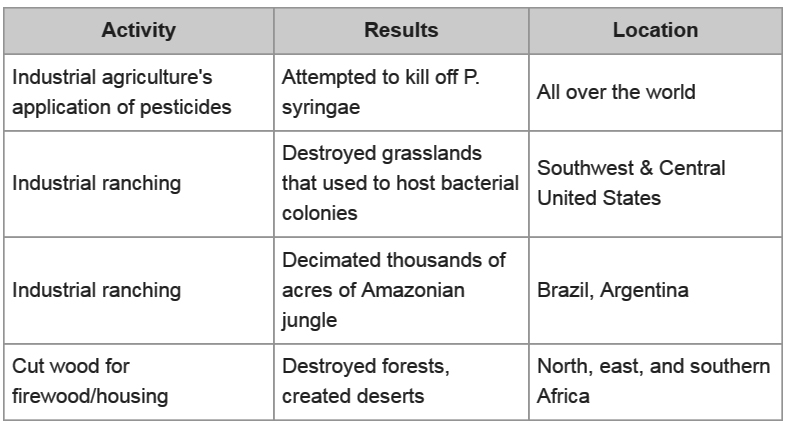
The following chart shows some examples
of how human activity has decimated
habitat for P. syringae:
How can we enhance, or at least rebalance,
Nature's ability to make clouds
with a bacteria that our farmers despise?
One good possibility is to pick a specific location
- say an island - on the windward side of dry lands
to cultivate the bacteria.
Let it multiply on its favorite plant/s there
and measure what happens when a good wind kicks up.
Then look to see when and
where it rains on the mainland nearby.
|
Weather Balance
Here is the ultimate goal:
To have a balance of biomes
in every continent
with just enough rain
to support them.
For example,
Australia could have green cities,
a desert, a forest, grasslands,
and seascapes,
instead of being primarily
a giant desert surrounded by ocean.
All of its citizens would have access
to drinking water
from groundwater, rainfall,
and/or a giant lake
in the interior.
Man would not be
at the mercy of the weather,
but would be able to predict when
and approximately
where precipitation would fall.
There would be no more wars based on
water scarcity
(though maybe on other things).
Palestine, Jordan, Pakistan would each
have their own water sources,
as would Israel and India.
Humankind would tip the scales
from identifying Pseudomonas syringae
as "bad" to recognizing
the essential constructive nature
of this rain-making bacteria
and maybe many other things
we've labelled "bad" as well.
Where there's a bad, there's always a good.
We need to look more often for the constructive,
useful side of what we have too long called "pests."
|
The Future of Pseudomonas Syringae
Dr. Lindow continued
his experiments with P. syringae,
subsequently discovering
a mutant bacterium
he called "ice-minus" strain,
that he then duplicated himself
via GMO experimentation.
When tested on several different crops,
the mutant strain worked
to prevent plants
from frosting even during cold weather.
This is good news for factory farms.
However, for anyone
depending on rainfall,
including farmers,
it may not be such good news.
If the strain competes
well enough with P. syringae
to drive it out,
it could create serious problems
with the weather.
Cold weather frosts and
bacterial ice action do destroy crops,
but crops cannot survive at all
without the precipitation generated
by ice-nucleating bacteria.
Continued experimentation is crucial
to increase our understanding
of the role P. syringae plays
within the hydrologic cycle,
and to find out how we can enhance,
rather than destroy,
its ability to create rain where it's needed.
|
นักวิทย์แดนจิงโจ้พิสูจน์ “ต้นไม้ยิ่งหด น้ำฝนก็ยิ่งหาย” |
ผยแพร่: 17 มี.ค. 2548 09:33:
รอยเตอร์ –
“ตัดไม้ทำลายป่า” มีผลโดยตรงต่อปริมาณน้ำฝน
นักวิทยาศาสตร์ออสเตรเลียพบ
การทำลายป่าบริเวณแถบแม่น้ำอเมซอนว่า
มีผลทำให้ปริมาณน้ำฝนแถบนั้นลดน้อยลง
และยังเป็นเหตุให้เกิดการเปลี่ยนแปลงอุณหภูมิในภูมิภาคดังกล่าว
แอน เฮนเดอร์สัน-เซลเลอร์ส
(Ann Henderson-Sellers)
ผู้อำนวยการด้านสิ่งแวดล้อม
องค์กรวิทยาศาสตร์นิวเคลียร์และเทคโนโลยี
ออสเตรเลีย (the Australian Nuclear Science
and Technology Organization)
เปิดเผยว่า
การศึกษาในแถบลุ่มน้ำอเมซอน (Amazon River) ในอเมริกาใต้
ทำให้นักวิทยาศาสตร์พบว่า
การสูญเสียป่านั้นมีผลต่อปริมาณไอน้ำ
ที่กลายเป็นไอและระเหยสู่ชั้นบรรยากาศ
นั้นหมายความว่า ทำให้
มีปริมาณฝนตกกลับมายังโลกน้อยลงกว่าเดิม
|
กุญแจสำคัญในการศึกษาครั้งนี้
คือการlสำรวจดูวงจรของโมเลกุลหนัก
ในรูปแบบของน้ำบริเวณอเมซอน
ซึ่งระเหยไอน้ำออกจากต้นไม้
มากกว่าทะเลสาบหรือแม้แต่แม่น้ำ
ทั้งนี้ น้ำจากก๊อกประปาตามบ้านนั้น
โดยปกติประกอบด้วยไฮโดรเจนซึ่งเป็น
โมเลกุลเบา 2 อะตอมและออกซิเจนโมเลกุลเบาอีก 1 อะตอม
แต่ว่าบางโมกุลของน้ำนั้น อะตอมที่ 2 ไฮโดรเจนเจนนั้น
กลับถูกแทนที่ด้วยโมเลกุลหนักที่เรียกว่า “ดิวเทเรียม” (deuterium)
”ต้นไม้ระเหยโมเลกุลของน้ำ
และสูบโมเลกุลเหล่านี้คืนกลับสู่ชั้นบรรยากาศ
โดยไม่เลือกระหว่างโมเลกุลหนักหรือเบา” เ
ฮนเดอร์สัน-เซลเลอร์ส อธิบาย
โดยขณะกำลังศึกษาวงจรของน้ำ
ที่ไหลออกจากแม่น้ำอเมซอนเข้าสู่มหาสมุทรแอตแลนติก
รวมถึงการระเหยเข้าสุ่ชั้นบรรยากาศ
จนควบแน่นกลายเป็นหยดน้ำฝนตกลงมาบนผืนโลก
ซึ่งนักวิทยาศาสตร์พบว่ามีปริมาณโมเลกุลหนักในน้ำลดลง
ตั้งแต่ช่วงปี 1970 เป็นต้นมา (หรือประมาณ 35 ปีที่แล้ว)
เฮนเดอร์สัน-เซลเลอร์ส เปิดเผยว่า
สิ่งที่สามารถอธิบายได้อย่างชัดเจน
ในขณะนี้สำหรับการลดปริมาณของโมเลกุลหนัก
ที่ไม่กลับคืนสู่ชั้นบรรยากาศ
นั่นก็เพราะมีต้นไม้ใบหญ้าน้อยเกินไป
ซึ่งเป็นสัญญาณสำคัญของความเชื่อมโยงระหว่าง
การตัดไม้ทำลายป่าและปริมาณน้ำฝน
”การศึกษาในท้ายที่สุดนี้กลับกลายเป็นครั้งแรก
ที่ทำให้พวกเราสามารถระบุถึง
ความแตกต่างระหว่าง
ความชุ่มชื้นที่ต้นไม้ระเหยออกมา
กับความชุ่มชื้นที่เป็นไอออกมาจากน้ำ
ซึ่งท้ายที่สุดก็เข้าสู่วงจรการหมุนเวียนของน้ำที่เหลืออยู่ภายในโลก”
”ต้นไม้ทำหน้าที่สำคัญในการดึงโมเลกุลหนักจากน้ำ
ออกสู่วงจรในระบบนิเวศน์
ซึ่งเป็นหลักฐานครั้งแรกที่อธิบายได้อย่างชัดเจนว่า
การตัดไม้ทำลายป่ามีผลโดยตรงต่อ
ปริมาณน้ำฝน” เฮนเดอร์สัน-แซลเลอร์ส อธิบาย
อย่างไรก็ดี แม่น้ำอเมซอนซึ่งยาวกว่า 4,000 ไมล์
นับได้ว่าเป็นแม่น้ำที่ยาวที่สุดอันดับที่ 2 ของโลก
ขณะเดียวกันป่าอเมซอนซึ่งมีเพื้นทีกว่า 2.3 ล้านตารางไมล์
ก็ได้รับขนานนามจากนักสิ่งแวดล้อมว่าเป็น “ปอดของโลก”
ในแต่ละปีเฉพาะช่วงฤดูฝนบริเวณอเมซอนมีฝนตกเฉลี่ย
มากถึงปีละ 6.5 ล้านลูกบาศก์ฟุตต่อวินาที
|
|

